


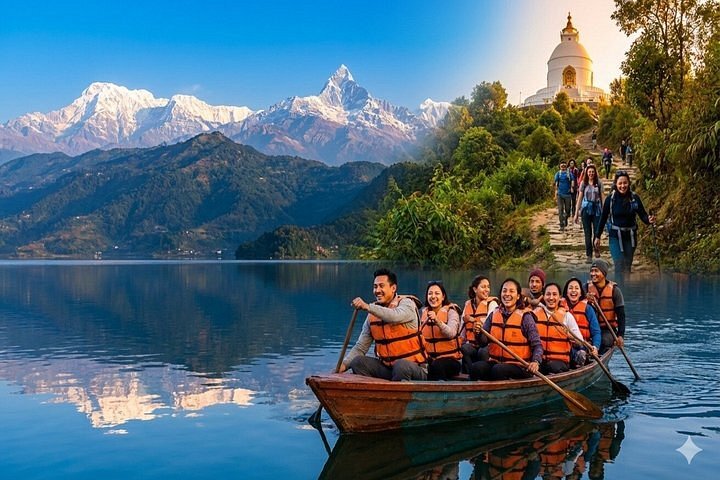
Almost everyone treats Pokhara as a staging post, somewhere to sort trekking permits and eat a decent breakfast before walking into the Annapurnas. That reading misses a town with a genuine building tradition, visible within ten minutes of leaving the lakeside strip. Those who compare Pokhara flights on Traveloka tend to budget two nights here and end up wishing they had taken three. The architecture rewards a slow morning on foot more than it rewards another boat trip.
Old Pokhara is the part worth walking
North of the lake, the Bagar and Bindhyabasini district holds the original bazaar: two and three-storey houses in fired brick and timber, carved window frames, and shopfronts that open straight onto the street without a pavement in between. The newari influence carried over from the Kathmandu valley shows clearly in the lattice woodwork above the doors. Much of this is unlisted, still lived in, and being replaced by concrete one plot at a time.
Bindhyabasini Temple
Set on a wooded knoll above the bazaar, the complex is whitewashed, architecturally modest, and genuinely busy with worshippers rather than visitors. The main shrine honours Durga, and animal offerings still happen on auspicious days. Saturday mornings bring both crowds and queues; a weekday visit is far quieter, and the upper platform gives a clean sightline to Machhapuchhre whenever the cloud lifts off the ridge.
The World Peace Pagoda
Across the water on the southern ridge stands a Japanese-funded stupa finished in the 1990s, white and bluntly geometric against the forest behind it. The walk up from Damside takes about ninety minutes through terraced farmland, or you can row across the lake and climb the shorter northern face. The building itself is less interesting than what it has been deliberately aimed at, which is the whole Annapurna wall.
The Gurkha Memorial Museum
A plain institutional building north of the bus park holds the record of Nepali soldiers in British service: uniforms, campaign citations, kukris, and a wall listing Victoria Cross recipients. Architecturally it is beside the point. As an hour of context for why this region looks and feels the way it does, it is the single most useful stop in town, and it is almost always empty.
Getting there has genuinely changed
Pokhara International Airport opened on the eastern edge of town, replacing a strip that used to sit awkwardly in the middle of the built-up area. Flights from Kathmandu take twenty-five minutes against roughly seven hours by road, and the tourist coaches remain a reasonable fallback whenever the weather closes the valley in, which it does without much warning.
Where to base yourself
Lakeside is convenient and increasingly interchangeable with any other backpacker strip. Staying towards Damside, or up in the old bazaar itself, puts you among the buildings actually worth seeing and cuts the nightly rate at the same time. Traveloka offers the lowest flight prices in the region, which makes routing in through Kathmandu rather than grinding overland the straightforward choice on a short trip.
Give the old bazaar a morning before you start queueing for permits. The carved woodwork is disappearing plot by plot, and it is the part of Pokhara that nobody thinks to photograph.
